Simeon Solomon
Solomon's Life Before 1873
By Roberto C. Ferrari
|
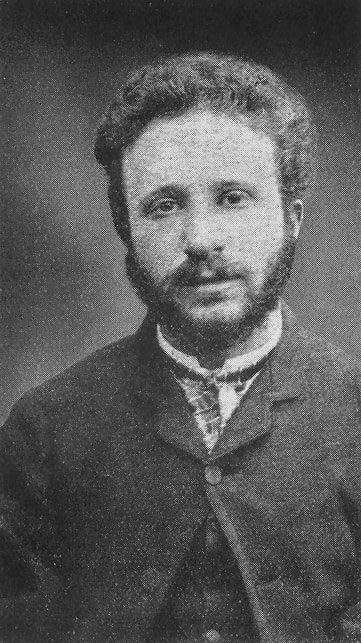
The life of the artist Simeon Solomon reads like the rise and fall of a celebrity. He was born in London on 9 October 1840, the last of eight children in an artistically-inclined middle class Jewish family. His mother Kate Levy Solomon was an amateur artist of miniatures, and his elder siblings Abraham (1823-1862) and Rebecca (1832-1886) were artists who were influential on Solomon’s early artistic development. He was officially admitted to the Royal Academy Schools on 24 April 1856, having been proposed by the Victorian painter Augustus Egg, R.A. About this time Solomon started an informal Sketching Club with his fellow students and friends Marcus Stone and Henry Holiday.
Solomon was early on influenced by Shakespeare and the Bible. His juvenilia reveals the influence of the then popular Pre-Raphaelites on him, in particular the work of Dante Gabriel Rossetti, whom he met probably in 1858 or shortly thereafter. It was also in 1858 that Solomon exhibited his first Royal Academy work, a drawing entitled “Isaac Offered”, and two additional drawings at the Ernest Gambart’s Winter Exhibition. Around 1860 Solomon met others in the Pre-Raphaelite circle, including Edward Burne-Jones, John Everett Millais, and William Holman Hunt. Georgiana Burne-Jones would recall later in life how Edward and she would marvel over Solomon’s skill as a draughtsman and how popular his sketchbooks were at the time. |
|
Solomon’s 1860 Royal Academy oil painting Moses was not well liked by many critics, but William Makepeace Thackeray paid him due compliments in his Roundabout Papers. The Pre-Raphaelite patron Thomas E. Plint purchased the picture and five others from Solomon, thus becoming one of his first important patrons. Other Old Testament-themed Royal Academy contributions from the next few years included Hosannah (1861) and The Child Jeremiah (1862). He would continue to exhibit at the Royal Academy until 1872.
In the spring of 1862, Solomon left his brother Abraham’s studio and took his own at 22 Charles Street near Middlesex Hospital. This significant move suggests his break from the shadow of his elder brother’s influence. Abraham Solomon had been a regular exhibitor at the Royal Academy for nearly 20 years by this time, and his reputation in the Victorian art world as a genre painter was great. Abraham’s death in December of that year sealed this transition, and Solomon would thereafter be seen as the greater artist by his Pre-Raphaelite colleagues. Another important event that took place at this time was Solomon’s introduction to the poet and critic Algernon Charles Swinburne through Burne-Jones or Rossetti. Swinburne’s love of classicism and erotica, would be heavily influential on Solomon, who soon afterwards created a sketch of the ancient Greek poetess Sappho and a watercolor of the poetess in a lesbian affair: Sappho and Erinna in a Garden at Mytilene (1864).
From this point in Solomon’s career, classicism became a dominant style for him. Following the lead of other artists such as Frederic Leighton, Edward Poynter, and Albert Moore, he began to paint classical works such as In the Temple of Venus (1863) and his 1865 Royal Academy work Habet!, considered by many to be Solomon’s best picture ever. Solomon took the first of three trips to Italy from 1866 to 1867, where he created some of his most beautiful pictures, including two versions of Bacchus (1867) and Heliogabalus, the High Priest of the Sun (1867). Solomon was on the administrative committee for the opening of the Dudley Gallery, a new venue for exhibiting watercolors and afterwards oil pictures, and he exhibited there regularly from 1865 through 1872.
Tied to his new classical style was Aestheticism, the idea of “art for art’s sake” propounded by Swinburne, John Abbott McNeil Whistler, and Walter Pater. Solomon was unique among the Aesthetes, however, in that he often depicted effete or languorous youths such as the Eros figures of Love in Autumn (1866) and Love Dreaming by the Sea (1871). In retrospect, it is apparent that these works represent Solomon’s attempt to explore his own homosexual identity during a time in Victorian England where male-male passion was a criminal offense and could only be expressed in a coded language. Certainly it was not only in these works that Solomon was exploring themes of homosexuality, as earlier in his life other works suggest such an affinity. These include the issue of bisexuality in the drawing The Bride, the Bridegroom, and Sad Love (1865), youthful religious boys in Two Acolytes Censing (1863), and the aforementioned depiction of Sappho and Erinna.
At the beginning of 1873 an event occurred which was to radically change the course of his life.
In the spring of 1862, Solomon left his brother Abraham’s studio and took his own at 22 Charles Street near Middlesex Hospital. This significant move suggests his break from the shadow of his elder brother’s influence. Abraham Solomon had been a regular exhibitor at the Royal Academy for nearly 20 years by this time, and his reputation in the Victorian art world as a genre painter was great. Abraham’s death in December of that year sealed this transition, and Solomon would thereafter be seen as the greater artist by his Pre-Raphaelite colleagues. Another important event that took place at this time was Solomon’s introduction to the poet and critic Algernon Charles Swinburne through Burne-Jones or Rossetti. Swinburne’s love of classicism and erotica, would be heavily influential on Solomon, who soon afterwards created a sketch of the ancient Greek poetess Sappho and a watercolor of the poetess in a lesbian affair: Sappho and Erinna in a Garden at Mytilene (1864).
From this point in Solomon’s career, classicism became a dominant style for him. Following the lead of other artists such as Frederic Leighton, Edward Poynter, and Albert Moore, he began to paint classical works such as In the Temple of Venus (1863) and his 1865 Royal Academy work Habet!, considered by many to be Solomon’s best picture ever. Solomon took the first of three trips to Italy from 1866 to 1867, where he created some of his most beautiful pictures, including two versions of Bacchus (1867) and Heliogabalus, the High Priest of the Sun (1867). Solomon was on the administrative committee for the opening of the Dudley Gallery, a new venue for exhibiting watercolors and afterwards oil pictures, and he exhibited there regularly from 1865 through 1872.
Tied to his new classical style was Aestheticism, the idea of “art for art’s sake” propounded by Swinburne, John Abbott McNeil Whistler, and Walter Pater. Solomon was unique among the Aesthetes, however, in that he often depicted effete or languorous youths such as the Eros figures of Love in Autumn (1866) and Love Dreaming by the Sea (1871). In retrospect, it is apparent that these works represent Solomon’s attempt to explore his own homosexual identity during a time in Victorian England where male-male passion was a criminal offense and could only be expressed in a coded language. Certainly it was not only in these works that Solomon was exploring themes of homosexuality, as earlier in his life other works suggest such an affinity. These include the issue of bisexuality in the drawing The Bride, the Bridegroom, and Sad Love (1865), youthful religious boys in Two Acolytes Censing (1863), and the aforementioned depiction of Sappho and Erinna.
At the beginning of 1873 an event occurred which was to radically change the course of his life.
Solomon's Life After 1873
By Carolyn Conroy
On the on the 11 February 1873, at the age of thirty-two and at the height of his artistic career, Solomon was arrested with George Roberts, a sixty-year-old illiterate stableman in a public urinal, by police constable William Mitchell, around the corner from Marylebone Lane Police Station, in Stratford Place Mews, off Oxford Street. On the following day magistrate, Lieutenant L. T. D’Eyncourt, of the Marylebone Police Court, read the charge that both men had “unlawfully attempt feloniously to commit the abominable crime of buggery”. Roberts protested that it was a false charge and when prompted, Solomon acquiesced that it was “equally so” with him. Despite their protests, both men were found guilty of attempted sodomy, but after his six week detainment in the Clerkenwell House of Detention, the artist was subsequently released to the care of his cousin Myer Salaman on a surety of £100, and the promise that he behaved himself. During this time Solomon was admitted to two separate private lunatic asylums in London, presumably by his desperate and confused family, but both visits were brief and on both occasions the artist was, unsurprisingly, discharged “unimproved”. Indeed, almost a year later, Solomon was arrested in Paris in a public urinal with male prostitute Henri Lefranc. The artist was charged with “outrage public à la pudeur”, or outrage to the public decency, and after conviction served three months in a Paris jail.
Solomon continued to produce work around the time of the London and Paris arrests, and in the early 1870s he completed a commission of four large watercolour paintings for a London solicitor, C. A. Swinburne, and is recorded as presenting himself to Devonshire society by giving public readings of Dickens' work. His artist sister Rebecca remained in their shared studio on London’s bohemian Fitzroy Street until at least the end of the 1870s and Solomon’s work continued to be exhibited in provincial galleries such as Liverpool, Manchester, and Birmingham as well as London.
Solomon continued to produce work around the time of the London and Paris arrests, and in the early 1870s he completed a commission of four large watercolour paintings for a London solicitor, C. A. Swinburne, and is recorded as presenting himself to Devonshire society by giving public readings of Dickens' work. His artist sister Rebecca remained in their shared studio on London’s bohemian Fitzroy Street until at least the end of the 1870s and Solomon’s work continued to be exhibited in provincial galleries such as Liverpool, Manchester, and Birmingham as well as London.
|
Nearly all of Solomon’s later work, of which there are perhaps four-hundred-plus known examples in existence, reflect his personal iconography or vision. Greatly influenced by Dante Gabriel Rossetti’s early poetry, this vision is rooted in his 1871 prose poem A Vision of Love Revealed in Sleep, which describes a narrator and his soul journeying through an unknown landscape whilst in a dream state where they experience visions of various forms and conditions of true love. Solomon’s personal journey of same-sex love, or ‘Divine Love’ as he alludes to it in the poem, reveals itself in the hundreds of works, many of them small chalk or pencil drawings and watercolours, produced over a period of thirty-three years from 1873 that reveal a complex private mythology of ideas which encompass a spiritual mix of Judaism, Catholicism, Buddhism, and Greek myth. Many of these images maintain Solomon’s earlier use of the sexual and moral ambiguity of the androgyne but are generally simpler in composition than his earlier work, often concentrating on an image of one or two heads in profile. The artist’s later work also reveals a move from the Pre-Raphaelitism of Rossetti to the fantasy of Symbolist imagery which suited his unique and personal journey.
In the 1880s and ‘90s, despite a dependency on alcohol, periods of chronic poverty and time spent in and out of the St. Giles Workhouse in one of London’s poorest areas, Solomon continued to work, supported by friends and family who had not abandoned him. His drawings and |
paintings were reproduced as photographic copies by London photographer Frederick Hollyer who had worked with many of Rossetti’s artistic circle in earlier times. This work found its way to Oxford’s student halls were a new generation of young men, including Oscar Wilde, were introduced to Solomon’s androgynous homoerotic imagery. Amongst these young men were Aesthetic poet Lionel Johnson, whose rooms on Fitzroy Street are recorded as being lined “wall to wall” with Solomon’s art. Johnson would eventually become part of the Rhymers’ group of poets alongside W. B. Yeats, Arthur Symons, and Ernest Dowson, and Solomon’s personal association and influence on members of the Rhymers’ would later be recorded by Yeats and others in published memoirs.
Another former Oxford student, and mutual friend of the Rhymers’ poets, whose interest in Solomon was also nurtured at Oxford, was the eccentric and flamboyant homosexual Count Eric Stanislaus Stenbock. Stenbock was an Anglo-Baltic-German aristocrat by descent, a friend of Wilde and More Adey, and thoroughly captivated by Solomon’s imagery. Seeking the artist out and befriending him, Stenbock became a patron of Solomon’s, giving him clothes, food and money, and providing the artist with a small studio in which to work. During the period of Stenbock’s patronage, which probably lasted until the Count’s premature death in 1895, Solomon’s work was published by designer Herbert Horne in Horne’s Arts and Crafts periodical The Century Guild Hobby Horse. The writer Edgar Jepson, who was a regular visitor to Rhymers’ meetings, described the Hobby Horse as “the link between the Pre-Raphaelites and the poets of the ‘nineties,’” and it seems fitting then that Solomon’s work was represented.
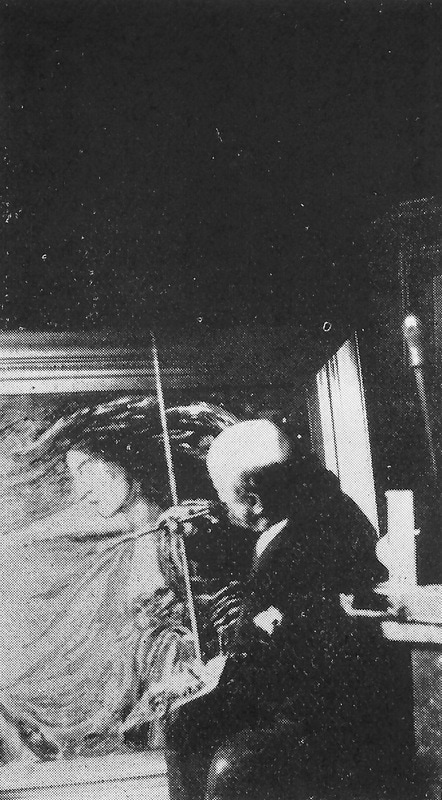
From 1892 the artist’s work was being sold on Oxford Street by W. A. Mansell & Co and was becoming well known in America, due to Frederick Hollyer’s export of Solomon’s androgynous and Aesthetic drawings. American journal The Art Amateur published a number of Solomon’s drawings during the 1890s, and advertised that Hollyer’s reproductions of Solomon’s work, alongside those of Rossetti and Burne-Jones, could be obtained through The London Art Publishers based in Philadelphia. In 1896 one hundred of Solomon’s watercolour paintings and drawings were exhibited at both the McClees Gallery in Philadelphia and the Klackner Gallery in New York. It is not unsurprising then that the first monograph on Solomon, published three years after his death in 1908, should be written by American author Julia Ellsworth Ford. Ford met Solomon towards the end of his life at a photographers studio in London. According to Ford’s description of her meeting with Solomon he appeared to be articulate, up-to-date with current affairs and still passionate about his work and his vision despite suffering from old-age, acute rheumatism and other ailments indicative of a life lived on the mean streets of nineteenth-century London.
Simeon Solomon died in the dining-room of St Giles Workhouse on 14 August 1905 at the age of sixty-five. He left behind a legacy of hundreds of works of art, and a uniquely inspiring story of a life lived without compromise to either his sexuality or his creativity.
From 1892 the artist’s work was being sold on Oxford Street by W. A. Mansell & Co and was becoming well known in America, due to Frederick Hollyer’s export of Solomon’s androgynous and Aesthetic drawings. American journal The Art Amateur published a number of Solomon’s drawings during the 1890s, and advertised that Hollyer’s reproductions of Solomon’s work, alongside those of Rossetti and Burne-Jones, could be obtained through The London Art Publishers based in Philadelphia. In 1896 one hundred of Solomon’s watercolour paintings and drawings were exhibited at both the McClees Gallery in Philadelphia and the Klackner Gallery in New York. It is not unsurprising then that the first monograph on Solomon, published three years after his death in 1908, should be written by American author Julia Ellsworth Ford. Ford met Solomon towards the end of his life at a photographers studio in London. According to Ford’s description of her meeting with Solomon he appeared to be articulate, up-to-date with current affairs and still passionate about his work and his vision despite suffering from old-age, acute rheumatism and other ailments indicative of a life lived on the mean streets of nineteenth-century London.
Simeon Solomon died in the dining-room of St Giles Workhouse on 14 August 1905 at the age of sixty-five. He left behind a legacy of hundreds of works of art, and a uniquely inspiring story of a life lived without compromise to either his sexuality or his creativity.